



OpenObserve Log Gateway
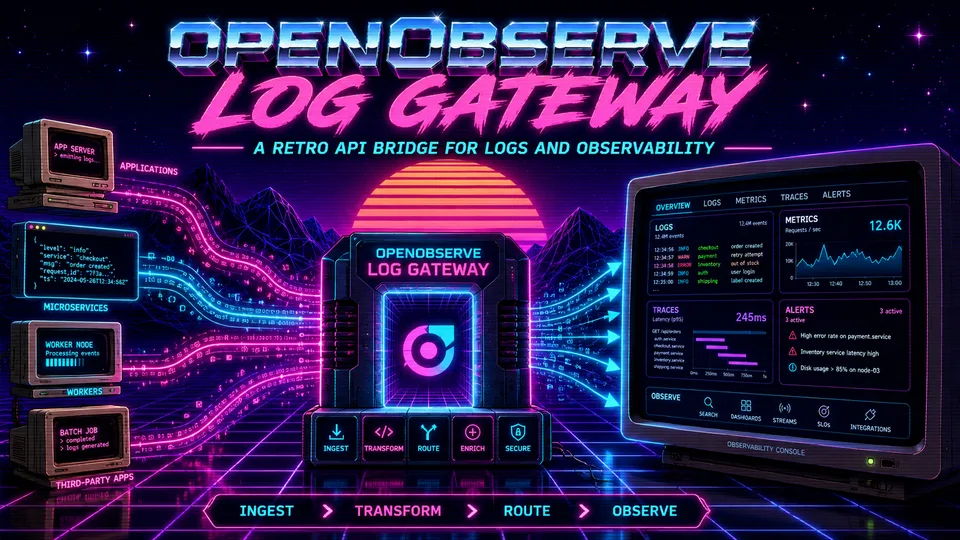
OpenObserve Log Gateway
Ever wondered how programmers know what is failing in an application when something goes wrong? The answer is logs (or activity records): a kind of onboard diary where the application writes everything it does step by step (from "User logged in" to "Error connecting to the database").
When we develop software with the help of Artificial Intelligence (AI) agents, we face a fascinating challenge: if the AI is programming or testing an application for us, how can it know what is failing under the hood? How can we give it "eyes" to understand the server's internal behavior in real time without compromising security?
To solve this, I developed OpenObserve Log Gateway.
What is it and what need does it solve?
It is an intermediate API (a gateway or pass‑through) that sits between my applications and OpenObserve (a modern, ultra‑fast, low‑cost log database).
Its main day‑to‑day functions are:
- Absolute security: Prevents our log‑database passwords from being exposed in public web applications (frontend) or clients. Applications only know a "quick access key" managed by the Gateway, and it handles secure storage.
- Data cleaning: If an application inadvertently sends sensitive information (like a password or a credit‑card token) in its logs, the Gateway intercepts it and masks it (
***redacted***) automatically before storing it. - Performance: Prevents the server from becoming slow when sending logs. It receives them instantly, queues them in memory, and sends them in optimized batches in the background.
The magical ingredient: Self‑diagnosis for Artificial Intelligences
The most innovative part of this project is not only how it protects and organizes logs from human users, but how my AI agents use it.
The automated workflow works as follows:
- Smart writing: When I code my applications, I configure the standard Node.js logging system (using the
Pino.jslibrary). Using its ability to connect to external transports, I instruct the AI agents to make the application automatically send its debug traces to our Gateway in real time. - Reading and understanding via MCP (Model Context Protocol): Through an MCP integration server I later built, the AI agents can perform structured and secure queries to this Gateway.
- The autonomy loop: When an error occurs in the code we are testing, the AI agent does not sit blind waiting for me to copy‑paste the console. It accesses the Gateway itself, securely queries the exact error logs, understands what failed (e.g., a mis‑defined variable or an unexpected server response) and applies the fix in the code by itself.
Benefits obtained
Thanks to this architecture, I have achieved a development environment where collaborating AIs are incredibly self‑sufficient when debugging problems. I have not only centralized observability of my projects in an economical and robust way, but also created an ecosystem where software can monitor, explain, and correct itself with minimal human intervention.